
As enterprise communications continue shifting to the cloud, the landscape of UCaaS (Unified Communications as a Service) has expanded into a web of acronyms, architecture choices, and connectivity models. It’s powerful, yes—but also a little overwhelming.
Each architecture balances technical depth with practical operational trade-offs, so whether you’re designing the voice topology or approving the budget, understanding how the models fit together is essential.
Zoom Phone is known for its architectural flexibility, supporting everything from fully cloud-native deployments to hybrid and on-premises configurations. In this deep dive, we’ll explore Zoom’s four primary connectivity models across three major pillars of enterprise voice:
- E911 for compliance with Kari’s Law and the RAY BAUM’s Act
- Local Survivability
- Advanced Call Routing
Architectural Note: You are not limited to choosing just one model. With Zoom’s Routing Rules, it is entirely possible to implement multiple connectivity models within a single tenant. This is especially valuable in multi-site global environments where specific offices must comply with regional telecom regulations.
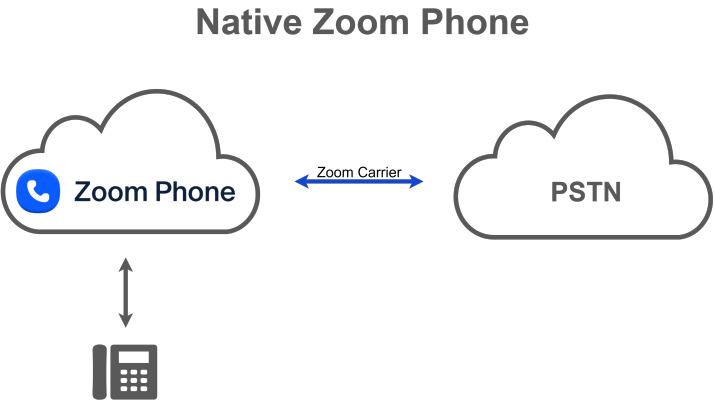
1. Native Zoom Phone
Zoom acts as both your UCaaS provider and your PSTN carrier. All call control, number management, and emergency services are handled directly in the Zoom cloud.
Ideal For
- Organizations with distributed or remote users
- Businesses looking to eliminate on-premises telephony infrastructure
- Rapid deployment with minimal IT overhead
Technical Details
- E911: Fully supported through Zoom Nomadic E911, including dynamic location updates for softphones, Zoom Rooms, and hardphones.
- Survivability: Out-of-the-box, this model does not offer local failover. However, Zoom Phone Local Survivability (ZPLS) is available as a lightweight virtual appliance that allows local calling and basic failover routing if cloud connectivity is lost. Because ZPLS requires an on-premises ZPLS server node, an SBC, and on-premises PSTN circuits, organizations with those components often find BYOC-P to be a more natural fit.
- Advanced Routing: Call routing is managed through the Zoom Admin Portal. While Native Zoom Phone has standard cloud routing rules, you can extend routing logic by leveraging regex-based Routing Rules and combining Native Zoom Phone with a BYOP-P configuration for complex scenarios.
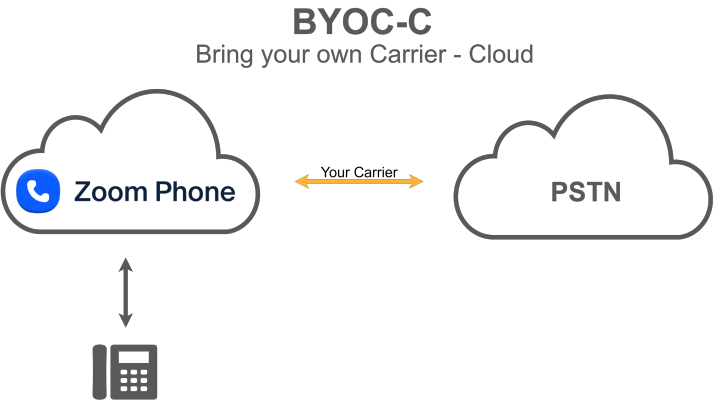
2. BYOC-C: Bring Your Own Carrier – Cloud (Cloud Peering PSTN)
In this model, your SIP carrier connects to Zoom Phone through a secure cloud peering relationship—no on-premises SBC is required.
Ideal For
- Enterprises that have preferred or pre-negotiated SIP trunk contracts
- Companies operating in countries where native Zoom PSTN is not available
Technical Details
- E911: For US and Canada customers, Zoom Nomadic E911 handles emergency calls, routing them through Zoom rather than the customer’s carrier. Outside of the US and Canada, emergency call handling depends on your carrier’s capabilities.
- Survivability: Like Native Zoom Phone, this model is cloud-only. There is no local fallback path unless paired with a ZPLS node—which is uncommon in pure BYOC-C deployments since there is typically no on-site SBC.
- Advanced Routing: Zoom handles routing in the cloud while allowing carrier-based routing policies to be enforced.
Regional Regulatory Note: Some BYOC-C providers offer a hybrid approach by deploying a provider-managed SBC at your premises. This allows them to connect directly to your local carrier while still peering with Zoom in the cloud—providing cloud flexibility while meeting strict telecom regulations in regions such as the UAE and the Kingdom of Saudi Arabia, where PSTN access must remain in-country.
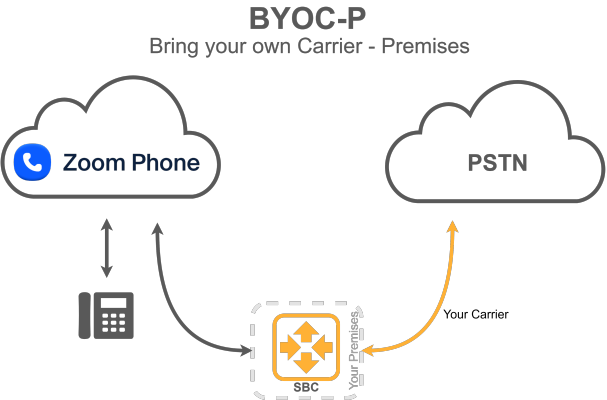
3. BYOC-P: Bring Your Own Carrier – Premises (Premises Peering PSTN)
You connect your SIP carrier to Zoom Phone through an on-premises Session Border Controller (SBC) that you manage.
Ideal For
- Enterprises requiring on-premises failover or branch survivability
- Sites with existing SBC infrastructure or strict security mandates
- Organizations requiring complex dial plan control and SIP header manipulation
Technical Details
- E911: For US and Canada customers, Zoom Nomadic E911 handles emergency calls through Zoom. Outside of the US and Canada, you implement E911 routing through your on-premises SBC to comply with local emergency dialing regulations.
- Survivability: The presence of a customer-managed SBC makes this model ideal for Zoom Phone Local Survivability (ZPLS). If cloud access is lost, the ZPLS node enables local call routing through your SBC’s SIP trunks—ensuring critical communications stay operational.
- Advanced Routing: Full flexibility. You control dial plans, digit manipulations, SIP headers, and conditional routing directly within your SBC.
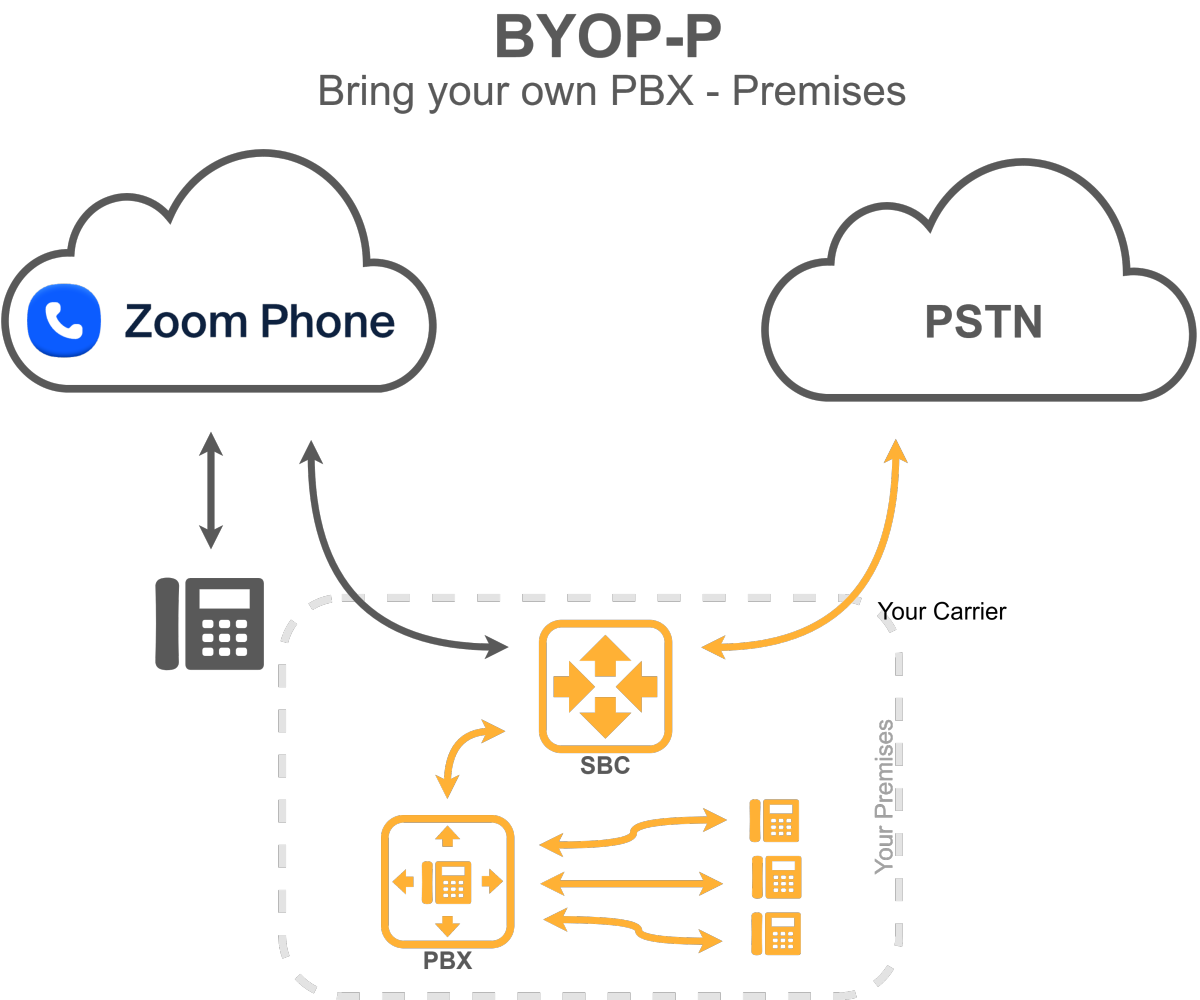
4. BYOP-P: Bring Your Own PBX – Premises (Premises Peering PBX)
Zoom Phone integrates with your on-premises PBX (e.g., Cisco CUCM, Avaya, Mitel) via a local SBC. This is ideal for phased migrations, internal call routing, or hybrid dial plans.
Ideal For
- Large enterprises transitioning from legacy PBX clusters to cloud voice over time
- Environments with specialized or compliance-heavy PBX integrations
- Maintaining specialized legacy endpoints alongside cloud users
Technical Details
- Prerequisite: BYOP-P builds upon a BYOC-P configuration. PBX endpoints route PSTN calls through the on-premises SBC and associated SIP circuits, enabling seamless extension dialing and interoperability between Zoom Phone users and on-premises PBX extensions during multi-phase migrations.
Summary Comparison
Each of Zoom’s voice architecture models offers a distinct balance of simplicity, control, and resiliency:
- Fastest path to the cloud: Native Zoom Phone is plug-and-play.
- Carrier flexibility without hardware: BYOC-C peers directly in the cloud.
- Local control, survivability & advanced SBC manipulation: BYOC-P is the strongest option.
- Phased migration or complex PBX coexistence: BYOP-P delivers hybrid flexibility.

Jaron Davis
Unified Communications Architect specializing in enterprise Zoom, Microsoft Teams, Cisco UC modernization, SIP/VoIP infrastructure, and systems architecture.